

The Algorithmic Oracle Fails the Beautiful Game: World Cup Stress-Tests the Limits of AI Predictive Modeling

NextFin News --The round of 16 knockout phase of the 2026 FIFA World Cup across Canada, Mexico, and the United States has arrived, bringing with it the cold, unyielding architecture of single-elimination play. In the group stage, the world is neatly sorted into a comforting gradient of soccer aristocracy and obvious underdogs. The knockouts, however, compress those performance margins into a frantic, nerve-shredding reality where survival is negotiated over ninety minutes, extra time, or the cruel lottery of penalty shootouts. Yet as athletic squads exhaust themselves on the grass, a parallel, high-stakes elimination trial is testing domestic generative artificial intelligence platforms off the field. This World Cup has quietly evolved into an unforgiving public theater where developer frameworks must prove whether their code can grasp the erratic, poetic rhythms of human sport.
The Unbearable Heaviness of Probability: Why Algorithms Misread the Beautiful Game
Across 92 completed tournament fixtures, the "World Cup Human-Machine Prediction Duel"—a joint benchmarking project launched by Lenovo and China Mobile’s Migu—published its latest analytical report card. On paper, the machines won: twelve leading Chinese LLMs achieved a collective accuracy rate of 64%, comfortably gliding past human trial participants who recorded an average baseline accuracy of 53.8%. China Mobile’s "Jiutian" framework claimed the top spot with 64 correct predictions, while Lenovo’s "Tianxi AI" and Alibaba’s "Qwen" tied for second with 63. But while predictive accuracy climbed from 61.9% in the group stage to 64% by the opening knockout round, technical experts and romantics alike agree on a vital caveat: these statistics do not mean the machines actually understand soccer.
The limitations of pure statistical induction became glaringly obvious whenever the tournament dared to stray from probability. Prior to a group-stage fixture between Spain and the tiny island nation of Cape Verde, eleven evaluated models projected a definitive Spanish victory, while one lone framework predicted an upset; the match concluded in a stubborn, uned 0-0 draw. Cape Verde subsequently secured a 2-2 draw against Uruguay and a 0-0 draw against Saudi Arabia to advance undefeated from its group—a sequence of fairy-tale outcomes that four of the twelve models failed to anticipate. Elsewhere, prominent frameworks like DeepSeek confidently picked the Netherlands to dispatch Morocco in regulation time, while institutional models from Panmure Liberum and Baichuan’s "Kimi" explicitly forecast tournament triumphs for the Netherlands and Germany, respectively. Both European giants were unceremoniously dumped out in the round of 32, leaving the automated models holding a collection of sophisticated, highly rational bad guesses.
Even the pre-tournament thought experiments felt brittle. Alibaba’s Qwen boldly projected that Kylian Mbappé would outscore Erling Haaland throughout the tournament, an analytical stance that clashed directly with the human intuition of veteran sports commentators like Huang Jianxiang. While forcing large language models to guess soccer scores serves a certain lighthearted, cultural purpose, the exercise holds genuine technical merit. It forces competing algorithms to sit for the same examination, under uniform public disclosure, judged by the cold reality of finalized, unalterable outcomes.
The core architectural issue is whether large language models are structurally capable of forecasting competitive sports. Experienced observers know that neither human pundits nor machine learning algorithms can achieve flawless predictive metrics; they can only generate outputs that maximize statistical proximity to a likely reality. At their fundamental layer, LLMs operate as inductive engines whose generative outputs are strictly bounded by historical context, prior training distributions, and the phrasing of incoming prompts. This is essentially an open-book evaluation: even if a model has not memorized a specific data anomaly, it can extrapolate a plausible, highly reasonable result based on historical averages.
But a soccer pitch is not a library, and matches cannot be solved through static text retrieval or comprehensive dataset memorization. Final outcomes are determined by volatile, real-time variables that defy clean data sets: sudden shifts in weather, the specific psychological weight of an injury, local pitch conditions, and the arbitrary whims of officiating decisions.
The structural format of the World Cup further confounds algorithmic forecasting. Standard soccer predictive models rely heavily on domestic club league data, where a season-long point accumulation matrix rewards consistency and penalizes reckless experimentation. A brief tournament structure, by contrast, is a sprint of only seven to eight fixtures. National squads cannot afford to deploy maximum energy across every consecutive group-stage match, which structurally accelerates the frequency of competitive upsets.
Furthermore, systemic structural changes to the 2026 World Cup format have amplified the chaos. Expanding the tournament from 32 to 48 national teams introduced international debutants like Cape Verde and Curaçao, whose historic operational datasets are virtually nonexistent, leaving AI training sets completely devoid of baseline parameters. Simultaneously, the structural modification of the game from traditional halves to a four-quarter format disrupted existing algorithmic models; while the software can calculate parameters like tactical schemes, stamina depletion, and team formations, it cannot anticipate how sudden regulatory structural pacing shifts alter live competitive rhythms.
Technical executives note that large language models face inherent structural barriers when predicting upsets because anomalies represent low-probability statistical events. If an LLM forcibly generates a low-probability anomaly as its primary output, it violates the probabilistic logic governing the model's design. Additionally, several traditional powerhouse teams entered this tournament with aging defensive and midfield rosters; because their group-stage opponents lacked the tactical capacity to exploit these structural liabilities, these vulnerabilities remained hidden within the historical training data.
AI practitioners note that current model behaviors in sports forecasting resemble text regurgitation rather than genuine prediction, essentially reorganizing consensus commentary already generated by human analysts. This explains the high degree of uniform alignment among competing LLMs; the models ingest identical public source information and apply highly similar reasoning logic. When confronted with structural variables like debutant teams with zero baseline history or systemic rule modifications, the algorithms exhibit the same analytical blind spots as casual human observers.
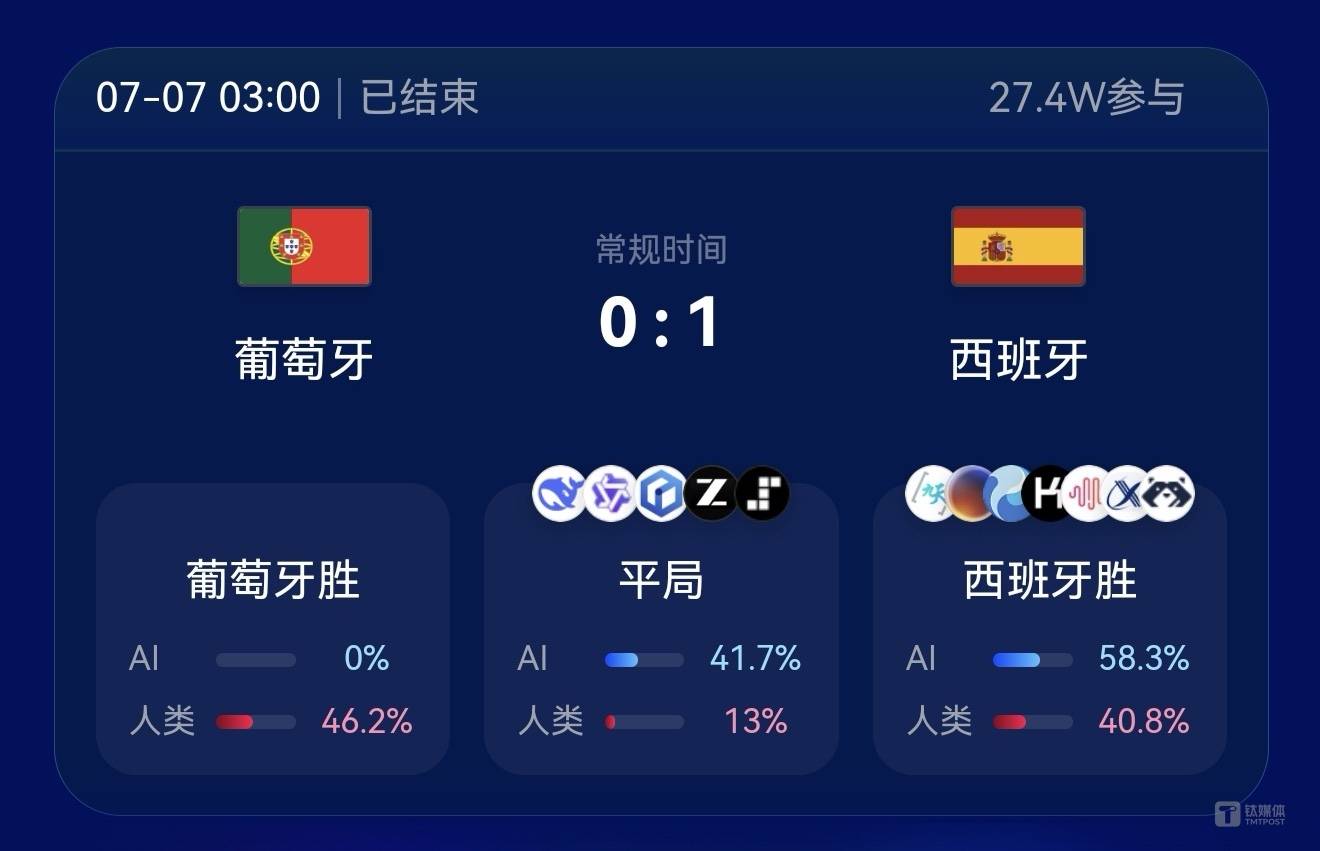
This was illustrated during a highly visible group-stage fixture where Portugal suffered a 0-1 defeat against Spain. Pre-match human consensus framed the match through a precise tactical balance: a 41-year-old Cristiano Ronaldo competing against an 18-year-old Lamine Yamal, an aging Portuguese squad facing a highly conditioned Spanish roster, and a tactical clash between Spain's 4-3-3 possession-oriented system and Portugal’s 4-2-3-1 defensive counter-attacking strategy. While Spain maintained an analytical advantage, human observers recognized that Ronaldo’s leadership could introduce unquantifiable field variables. Out of more than 270,000 public participants tracking the match, seven AI models projected a Spanish victory and five predicted a draw; not a single LLM forecast a Portuguese win. The models consistently backed the highest statistical probability, whereas half of the human participants chose to back Portugal, highlighting the abstract human variables that algorithms fail to capture.
The Evolution of Generative AI from Forecasting Engines to Operational Advisory Workflows
Beyond score predictions, artificial intelligence has established deep integration across tournament operations, ranging from team preparation and officiating support to broadcasting and event management. Technologies such as Semi-Automated Offside Technology (SAOT), smart ball chips, automated statistics, heatmaps, and athletic performance ratings represent mature operational deployments.
The official match ball, Trionda, features an integrated 500Hz inertial measurement unit sensor that captures data 500 times per second regarding touch impact, velocity, spin, and trajectory. This data feeds directly into the Video Assistant Referee (VAR) system, as seen during a June 20 fixture between Sweden and Tunisia, where sensor timestamps provided the critical verification needed to rule Mattias Svanberg's goal onside.
At the enterprise level, FIFA launched its AI Pro super-agent system for the 2026 tournament to support analysts and coaches across all 48 competing federations. Gong Haoning, Lenovo’s Emerging Vertical AI Solutions Delivery Manager and project lead for the World Cup AI Super-Agent and FIFA Intelligent Command Center, documented an operational case where a national team suffered a significant defeat in its opening match. The following day, team analysts utilized the AI Pro system to query formation metrics, receiving precise data on squad width, length, and defensive positioning. When analysts pushed further on defensive vulnerabilities regarding line-breaking passes, the system identified specific weaknesses in the team's response to through-balls and provided targeted adjustment strategies for the fullbacks and defensive midfielders.
Despite tight three-to-four-day intervals between World Cup matches, coaching staffs consistently dedicate 30 to 60 minutes per session to the AI Pro system. Every competing federation has utilized the platform at least once, with high-intensity users submitting dozens to over a hundred queries per match, driving total system volume to 200–300 technical inquiries daily.
The system relies on multi-agent architectures and specialized sports knowledge graphs that integrate over 2,000 distinct data indicators and millions of data points. By processing natural language queries, it generates passing maps, heatmaps, video segments, and 3D positional reconstructions. This deployment has effectively democratized elite sports analytics, granting debutant nations immediate access to tactical insights previously restricted to premium-budget federations.
While the integration of generative AI models in professional football remains iterative, industry experts emphasize that the technology serves as a powerful advisory mechanism rather than a replacement for human coaching experience, as algorithms remain inherently limited in capturing the psychological resilience and unpredictable competitive spirit that define the sport.
(Author | Yang Li, Editor | Yang Lin)